
Quick answer: Phoria lab results help customers review batch-level quality information, including product identity, alkaloids, heavy metals, microbes, and product-specific testing where applicable.
Lab results are most useful when customers understand what they are looking at. A Certificate of Analysis should not be treated as decoration. It is a quality record that needs to match the product, batch, and test categories being reviewed.
This page explains the main sections of a kratom COA and how Phoria customers can use lab results alongside product pages, batch lookup, and support.
Important: Phoria Kratom products are intended only for adults 21+. These products have not been evaluated by the FDA and are not intended to diagnose, treat, cure, or prevent any disease. Kratom may cause side effects, dependence, withdrawal, or interactions with medications, alcohol, and other substances. Do not use if pregnant or nursing, and check local law before ordering.

The COA Fields To Check First
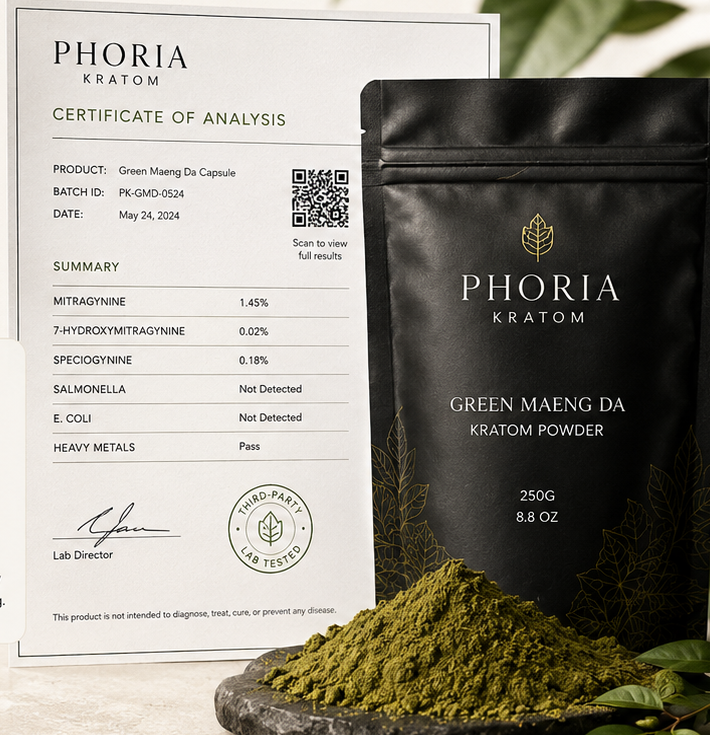
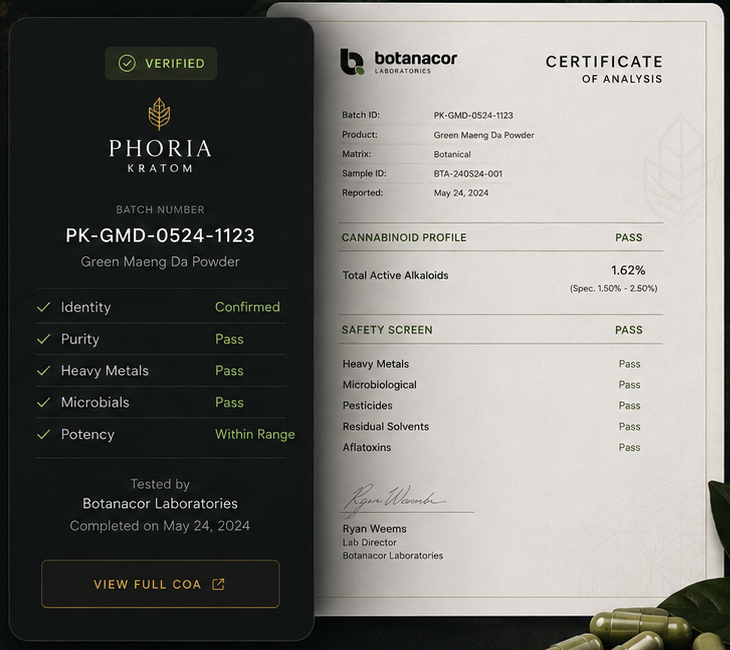
Start at the top of the report. Confirm the product name, batch number, sample ID, testing laboratory, and date. If those fields do not match your product, do not assume the document applies.
Next, review the analytes and result values. A clear COA should show what was tested, the units used, the result, and whether the result meets the applicable internal specification or safety threshold.
Common Kratom Testing Categories
| Category | Why it matters | Typical examples |
|---|---|---|
| Alkaloids | Helps characterize product strength and label consistency. | Mitragynine and 7-hydroxymitragynine. |
| Heavy metals | Checks environmental contaminants that can appear in agricultural products. | Lead, arsenic, cadmium, and mercury. |
| Microbials | Checks hygiene and pathogen risks from plant material and processing. | Salmonella, E. coli, yeast and mold, aerobic plate count. |
| Product-specific panels | Checks risks tied to a format or process. | Residual solvents for extracts, or other targeted panels. |
How To Interpret Results Carefully
Reports can use different units, method names, and presentation styles. If a value is hard to interpret, the safest next step is to contact support rather than guessing.
Lab results also have limits. They describe the tested sample and batch record. They do not prove a medical benefit, guarantee a personal experience, or remove the need for responsible adult use.
Where To Go Next
If you have a product in hand, start with Batch Lookup. If you want to understand the testing program, read Lab Testing. If you want the broader quality framework, review Quality Standards and Our Process.
Phoria Lab And Quality Resources
Use these pages together. Lab testing explains what is tested, lab results explain how to review reports, batch lookup explains how to connect a package to a record, and quality standards explain the larger system behind the product.
 Lab Testing
What Phoria tests for and why third-party testing matters.
Lab Results
How to read COAs, result fields, and batch-level documentation.
 Batch Lookup
How to connect a product package with available documentation.
 Quality Standards
The sourcing, labeling, testing, and support standards behind the brand.
Research And Quality Benchmark Sources
These lab and transparency pages are informed by consumer safety resources from the FDA, kratom research summaries from NIDA, and the American Kratom Association GMP Standards Program. They also follow common high-quality kratom industry expectations: batch records, COA access, independent lab testing, alkaloid review, heavy metals testing, microbial testing, and clear customer support paths.
FAQs
What is a kratom lab result?
A kratom lab result is a testing record for a product sample or batch. It may include alkaloids, heavy metals, microbial results, and other product-specific checks.
What is the difference between lab results and a COA?
A COA is a common format for reporting lab results. It usually lists the product, batch or sample ID, lab information, testing date, methods or analytes, and result values.
Which results matter most for kratom?
Useful kratom result categories include alkaloid potency, 7-hydroxymitragynine monitoring, heavy metals, microbial safety, identity, and product-specific panels such as residual solvents for extracts.
Can lab results vary by batch?
Yes. Kratom is a botanical ingredient, so results can vary by harvest, processing, storage, and finished product format. That is why batch-level records are more useful than generic claims.